Wildfire Mitigation Tree Services Every Property Owner Should Consider
Wildfire risk is no longer a concern reserved for remote cabins tucked into dense timber. It affects suburban edges, rural homes, commercial sites, vineyards, HOAs, and even properties that only back up to a greenbelt or drainage corridor. I have seen owners assume their risk was low because they kept the lawn watered and cleared leaves from the gutters, only to learn that the real problem sat twenty feet away in the form of overgrown conifers, ladder fuels, deadwood, and poorly maintained trees pressing into structures.
Wildfire behavior around homes is unforgiving. A fire does not need a wall of flames to destroy a property. Wind-driven embers can travel far ahead of a fire front, land in receptive vegetation, and turn an ordinary landscape into a series of ignition points. Trees often play a central role in that chain. When they are healthy, well-spaced, and properly maintained, they can be an asset. When they are stressed, overcrowded, or structurally compromised, they can become one of the biggest liabilities on the site.
That is why wildfire mitigation is not simply a matter of cutting everything down. Good mitigation work is selective, technical, and highly site-specific. The right combination of Tree Removal Services, Tree Pruning & Crown Shaping, Stump Removal & Grinding, Emergency Tree Services, and Certified Arborist Consultation can reduce risk without stripping a property of shade, beauty, or long-term ecological value.
Why tree work matters so much in wildfire planning
People often think in terms of horizontal spread, meaning brush or grass carrying fire across the ground. Trees introduce vertical and overhead pathways. Low branches can allow fire to climb from surface fuels into the canopy. Dense crowns can help fire move from tree to tree. Dead snags, hollow trunks, bark pockets, and accumulated debris at the base of a tree all increase the chance that heat and embers will find a foothold.
A single neglected tree can create several problems at once. It can lean toward a roof, drop embers onto a deck, shed dead limbs during a wind event, and trap leaf litter in corners that stay dry all summer. On larger parcels, I have seen tree lines act like fuse cords, leading fire straight toward a residence from a roadway or adjacent lot. On smaller lots, the issue is often spacing and branch clearance rather than sheer volume of vegetation. In both cases, the goal is the same: reduce the chance that trees will carry, intensify, or reintroduce fire near structures.
There is also a timing issue that property owners underestimate. Wildfire mitigation work takes planning. Permits may be required. Some species are protected. Utility conflicts, slope access, crane logistics, nesting season, and disposal all affect cost and schedule. Waiting until red flag conditions arrive is usually too late. That is when contractors are overloaded, burn restrictions tighten, and the margin for safe work shrinks.
Certified Arborist Consultation should come first
The most useful wildfire mitigation projects begin with a trained set of eyes on the property. A Certified Arborist Consultation is not just a tree health check. It is a strategic review of how vegetation, structures, topography, and maintenance patterns interact.
A good arborist will look at species composition, canopy density, branch architecture, stress symptoms, decay indicators, and root zone conditions. They will also read the site itself. South-facing slopes dry out faster. Narrow driveways complicate emergency access. Retaining walls can alter root stability. Outbuildings, fences, propane tanks, and wood piles all influence where tree work should be prioritized.
This matters because wildfire mitigation is full of trade-offs. Removing one large tree might reduce direct flame exposure near a structure, but if that tree provided critical shade that kept understory fuels moist, taking it out without a broader plan can create a hotter, drier microclimate. Likewise, aggressive pruning can reduce ladder fuels, but poor cuts or over-thinning can stress a tree and leave it more vulnerable to insects, sunscald, or failure later.
An experienced arborist helps separate cosmetic work from risk reduction. I have walked properties where owners wanted to spend money lifting every canopy uniformly, even in places where the real threat came from dead junipers packed against a fence line. I have also seen mature oaks marked for removal when strategic pruning and debris management would have delivered most of the fire-safety benefit at far lower ecological and financial cost.
Dangerous Tree Assessment and Removal is often non-negotiable
Some trees are simply too risky to keep. A Dangerous Tree Assessment and Removal process focuses on identifying trees that could fail during wind, drought, fire activity, or suppression operations. In wildfire country, dangerous trees are not just those likely to fall on a house. They also include trees that can torch easily, throw heavy dead limbs, or block evacuation routes and firefighter access.
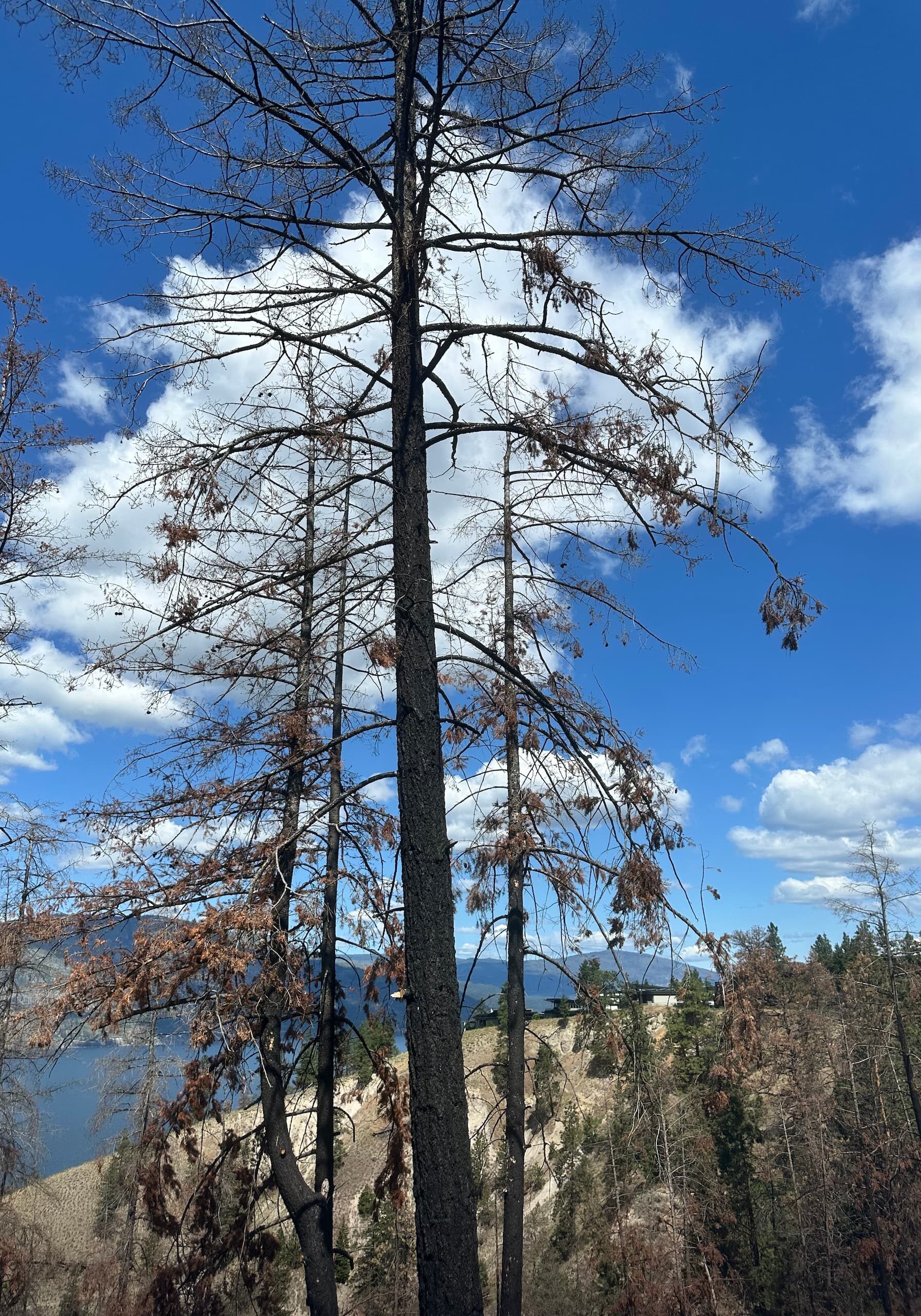
Common red flags include advanced decay, large dead tops, root plate movement, severe lean, fire scars from previous burns, bark beetle damage, and extensive deadwood in species that already carry fire readily. Eucalyptus, pines, cedars, firs, and junipers each present different risk profiles depending on the region, moisture conditions, and maintenance history. No species is automatically bad, but some demand closer management than others.
Tree Removal Services become necessary when mitigation pruning cannot reasonably bring the risk down. This is especially true for trees within the immediate vicinity of structures, trees with major defects over driveways, or groups of suppressed and dying trees in overcrowded stands. On one foothill property I visited, three small pines had grown into a tight cluster between a garage and a wooden fence. The owner liked them because they screened the neighbor’s yard. Unfortunately, the crowns touched the eaves, the lower limbs swept the fence, and each trunk carried years of dead interior branching. Removing those three trees likely reduced the site’s wildfire exposure more than any other single action.
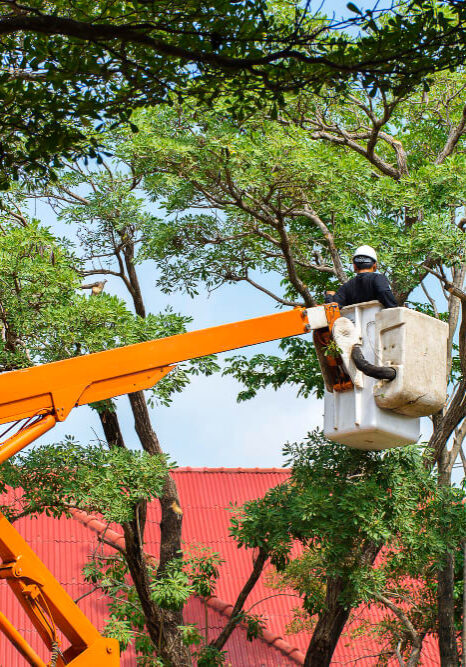
Removal does not have to mean over-clearing. In fact, indiscriminate clearing can create erosion, invasive weed pressure, and excessive sun exposure. The best work removes what is hazardous, retains what is defensible, and reshapes the site so maintenance stays manageable.
Tree Pruning & Crown Shaping can change fire behavior around a home
There is a major difference between aesthetic trimming and wildfire-focused Tree Pruning & Crown Shaping. The objective is not to make every tree look sculpted. It is to reduce fuel continuity, remove dead material, improve separation, and preserve tree health.
Proper crown work often includes raising lower limbs to limit ladder fuels, reducing overcrowded sections to improve airflow, and removing dead, broken, or rubbing branches that add combustible material. Crown shaping may also create clearer separation from roofs, chimneys, decks, and overhanging structures. The exact clearance depends on species, local codes, slope, and exposure, but the principle is consistent: the tree should not act as a direct bridge to the home.
Pruning for wildfire mitigation requires restraint. Taking too much live canopy at once can trigger stress, weak regrowth, and long-term decline. In some species, heavy pruning also stimulates dense sprouting, which later recreates the very fuel problem the owner paid to reduce. Timing matters too. Certain cuts during peak heat or active pest periods can do more harm than good.
One practical example is the difference between thinning a live oak and thinning a pine. A live oak may tolerate selective interior pruning well if done thoughtfully. A pine with resinous wood and dead lower branches may benefit more from limb lifting and removal of nearby competing fuels than from aggressive canopy thinning. The work may look less dramatic when finished, but it is often more effective and healthier for the tree.
Stump Removal & Grinding is about more than appearance
After trees are removed, many owners stop there. From a wildfire standpoint, that can be shortsighted. Stump Removal & Grinding can play an important role, especially when the stump sits close to buildings, fences, or paths of travel.
A fresh stump does not usually present the same immediate fire risk as a dry slash pile, but old stumps can harbor rot, collect debris, encourage insect activity, and interfere with grading or defensible space improvements. In some cases, they continue to sprout vigorously, creating a thicket of highly flammable regrowth. I see this often with species that respond aggressively after cutting. What looked like a clean removal one season becomes a waist-high fuel source the next.
Grinding also makes the site easier to maintain. Mowing, raking, irrigation adjustments, and surface fuel clearance are simpler when there is no stump Emergency Tree Services Ace Tree Services Ltd. forcing people to work around it. On tighter residential lots, that practical benefit matters. A mitigation plan that is hard to maintain is less likely to be maintained well.
There are exceptions. On steep slopes or in sensitive areas, full stump removal may disturb soil more than is desirable. In those situations, the contractor and arborist may recommend grinding to a manageable depth, leaving roots in place for stability, then addressing surface fuels and replanting with more fire-conscious materials.
Tree Cable and Bracing can preserve valuable trees without ignoring risk
Wildfire mitigation does not always point toward removal. Sometimes the smarter move is to preserve a significant tree while reducing its structural vulnerability. Tree Cable and Bracing can help support trees with codominant stems, weak unions, or heavy limbs that might otherwise fail during wind, drought stress, or emergency conditions.
This is not a fireproofing system, and it should never be used as an excuse to keep a tree that is fundamentally unsafe. But in the right case, it is a useful tool. Large shade trees near homes often provide cooling, privacy, and property value. If one has a manageable structural defect, supplemental support combined with selective pruning may offer a better outcome than removal.
The key is judgment. Cable systems require proper design, installation, and inspection. Hardware that is poorly chosen or never revisited can create a false sense of security. I have seen owners assume that a braced tree is “fixed forever.” It is not. Trees grow, loads change, and wildfire regions impose extra stress through heat, drought, and sometimes post-fire instability in nearby soils.
Where Tree Cable and Bracing fits best is in a broader management strategy. The tree remains, the defect is managed, competing fuels are reduced, and branch architecture is adjusted so the canopy is less likely to contribute to structure ignition.
Emergency Tree Services matter before and after the fire front
Many people associate Emergency Tree Services with storm damage, but wildfire seasons generate their own urgent tree problems. High winds, drought-cracked limbs, partially burned trunks, vehicle impacts during evacuations, and suppression-related damage can all create immediate hazards.
Before a fire reaches an area, emergency crews may be called to remove a split limb over a driveway, clear a fallen tree from an access road, or address a snag threatening power lines or a structure. Timing is critical because blocked access can endanger both residents and first responders. I have seen situations where a single downed limb delayed equipment access to a property that otherwise had a defensible perimeter.
After a fire, the need often becomes even greater. Trees that appear to have survived may have hidden damage in the cambium, roots, or scaffold unions. Some fail weeks later after the first strong wind. Others retain enough green foliage to reassure the owner, even though the structural wood has been compromised. Post-fire assessments should be methodical, especially around homes, roads, barns, and recreation areas.
Emergency work also needs caution. A partially burned tree is unpredictable. Internal charring can hollow out critical wood while the exterior still looks reasonably intact. Limbs can snap under rigging loads that a healthy tree would tolerate. This is not a place for improvised chainsaw work by property owners.
The services that usually make the biggest difference
On most properties, wildfire mitigation tree work falls into a small set of high-value actions. The exact order depends on the site, but these are the services I see delivering the clearest safety benefits:
- Certified Arborist Consultation to identify true hazards, preserve healthy assets, and build a plan that fits the site.
- Dangerous Tree Assessment and Removal for dead, unstable, overcrowded, or high-combustibility trees near structures and access routes.
- Tree Pruning & Crown Shaping to break fuel continuity, reduce dead material, and improve clearance from roofs and decks.
- Stump Removal & Grinding where old stumps interfere with defensible space, maintenance, or create persistent regrowth and debris accumulation.
- Emergency Tree Services for urgent failures, post-fire damage, and access issues that cannot wait for routine scheduling.
If budget is tight, it is usually better to do the highest-risk work thoroughly than to spread resources thinly across cosmetic trimming. A sound consultation helps prioritize that sequence.
What property owners should look for before hiring a contractor
Not every tree company is equipped for wildfire mitigation. Some are excellent at ornamental pruning but have limited experience with defensible space planning. Others can remove large trees safely but do not have arboricultural training to distinguish between a tree that needs reduction and one that needs removal.
Ask direct questions. Does the crew have experience with wildfire-prone properties? Can they explain why each recommended action reduces fire risk? Will they identify which trees should stay and why? Do they account for species behavior, spacing, and long-term maintenance? If a crane, lift, or chipper is needed, is site access feasible without damaging retained trees or critical infrastructure?
Documentation helps as well. A written scope prevents misunderstandings, especially where multiple services are involved. If the plan includes Tree Removal Services, Stump Removal & Grinding, and Tree Pruning & Crown Shaping in phases, each phase should be clear. Homeowners are often surprised by how much slash volume a moderate project generates. Chipping, hauling, stacking, and disposal should be discussed up front because slash left on site can undo much of the benefit.
Insurance, worker safety practices, and local compliance matter too. Wildfire mitigation often takes place on slopes, near structures, and around utilities. That is inherently high-risk work. A low bid can become expensive if the crew lacks the skill to execute technical removals or makes cuts that compromise the health of valuable retained trees.
A sensible rhythm for ongoing maintenance
Wildfire mitigation is not a one-time event. Trees grow, weather shifts, pests move in, and previously healthy specimens can decline under drought stress. What was safe three years ago may not be safe now. The best properties treat mitigation as a recurring maintenance cycle rather than a dramatic cleanout every decade.
A practical pattern usually includes annual walk-throughs before peak fire season, more detailed arborist reviews every few years, and immediate reassessment after severe wind, heavy snow, lightning, or nearby fire activity. Young trees need training so they do not become future hazards. Mature trees need careful monitoring so structural defects are caught before they become emergencies.
This is also where aesthetics and safety can coexist. A property does not have to look stripped to be defensible. In fact, landscapes that are maintained consistently often look more intentional and more attractive than those that swing between neglect and aggressive clearing. Thoughtful spacing, healthy canopies, clean branch structure, and managed understory create a landscape that performs better under stress and remains easier to live with year-round.
Warning signs that should not wait until next season
Certain conditions deserve prompt attention, especially in fire-prone areas:
- Dead branches over roofs, decks, driveways, or propane tank areas.
- Tree crowns touching structures, chimneys, or each other in dense groupings.
- Leaning trees, root heaving, trunk cracks, or recent limb failures.
- Stressed or dying conifers showing rapid browning, pitch flow, or bark loss.
- Old stumps and vigorous stump sprouts building fuel close to structures or fence lines.
These are not subtle landscape issues. They are common precursors to more expensive and dangerous problems.
The broader payoff of doing this work well
Wildfire Mitigation Tree Services are often discussed in terms of prevention, and rightly so, but the benefits run wider than that. Well-executed tree work can improve emergency access, reduce routine cleanup, preserve healthier canopy cover, and lower the chance that one neglected corner of the property becomes the origin point for a much larger loss. It can also spare owners from rushed decisions under pressure, when smoke is in the air and every contractor’s phone is ringing.
The properties that fare best are rarely the ones that removed the most trees. They are the ones where owners understood the role each tree played, asked for expert guidance, and invested in targeted, defensible work. They removed dangerous specimens, pruned with purpose, dealt with the leftovers properly, and kept the landscape in a condition they could actually maintain.
That is the practical value of Tree Removal Services, Certified Arborist Consultation, Dangerous Tree Assessment and Removal, Tree Cable and Bracing, Emergency Tree Services, Stump Removal & Grinding, and Tree Pruning & Crown Shaping when they are used intelligently. They turn tree care from a reactive chore into a core part of wildfire readiness. For property owners in fire-prone regions, that shift is not cosmetic. It is essential.
Name: Ace Tree Services Ltd.
Address: 4656 Wallace Hill Rd, Kelowna, BC V1W 4C2, Canada
Phone: 250-212-9593
Website: https://acetree.ca/
Email: [email protected]
Hours:
Sunday: Closed
Monday: 7:00 AM–5:00 PM
Tuesday: 7:00 AM–5:00 PM
Wednesday: 7:00 AM–5:00 PM
Thursday: 7:00 AM–5:00 PM
Friday: 7:00 AM–5:00 PM
Saturday: 7:00 AM–5:00 PM
Time zone: Pacific Time
Open-location code / Plus code: RHF8+8G Kelowna, British Columbia, Canada
Map/listing URL: https://www.google.com/maps/search/?api=1&query=Google&query_place_id=ChIJxRVIBx2LfVMRNRSkp6-IC0U
Embed iframe:
Socials:
https://www.facebook.com/p/Ace-Tree-Services-61585901931447/
Ace Tree Services Ltd. provides professional tree care from its Kelowna location on Wallace Hill Road.
The official website lists tree removal, stump removal and grinding, tree pruning and crown shaping, emergency tree services, certified arborist consultation, dangerous tree assessment and removal, tree cabling and bracing, and wildfire mitigation.
Ace Tree Services serves homeowners, businesses, and property owners in Kelowna and throughout the Okanagan Valley.
The company’s official site highlights ISA Certified Arborist support, local Okanagan experience, and fully insured tree service work.
Customers can contact Ace Tree Services for planned tree maintenance, high-risk removals, storm-related tree concerns, pruning, stump grinding, and arborist consultation needs.
The supplied public listing address is 4656 Wallace Hill Rd, Kelowna, BC V1W 4C2, near rural and residential service areas in southeast Kelowna.
For tree services in Kelowna and the Okanagan, call 250-212-9593, email [email protected], or visit https://acetree.ca/
The public map listing uses plus code RHF8+8G Kelowna, British Columbia, Canada and can help customers find Ace Tree Services Ltd. near Wallace Hill Road.
Popular Questions About Ace Tree Services Ltd.
What does Ace Tree Services Ltd. do?
Ace Tree Services Ltd. provides tree removal, stump removal and grinding, tree pruning and crown shaping, emergency tree service, certified arborist consultation, dangerous tree assessment and removal, tree cabling and bracing, and wildfire mitigation.
Where is Ace Tree Services Ltd. located?
Ace Tree Services Ltd. is listed at 4656 Wallace Hill Rd, Kelowna, BC V1W 4C2, Canada.
What phone number should customers call?
Customers can call Ace Tree Services Ltd. at 250-212-9593.
What is the email address for Ace Tree Services Ltd.?
The supplied email address is [email protected].
What are Ace Tree Services Ltd.’s hours?
The supplied listing hours show Monday through Saturday from 7:00 AM to 5:00 PM, with Sunday closed, Pacific Time. The official website lists 7:00 AM to 5:00 PM, Monday through Friday, so customers should confirm Saturday availability before booking.
Does Ace Tree Services Ltd. provide emergency tree service?
Yes. The official website lists emergency tree services, including emergency tree removal, dangerous tree assessment, emergency stabilization, and limb or branch cleanup.
Does Ace Tree Services Ltd. offer arborist consultations?
Yes. The official services page lists certified arborist consultation as one of the company’s Okanagan tree services.
Does Ace Tree Services Ltd. provide stump grinding?
Yes. The official services page lists stump removal and grinding as a service.
What areas does Ace Tree Services Ltd. serve?
The official website states that Ace Tree Services serves Kelowna and the Okanagan Valley.
How do I contact Ace Tree Services Ltd.?
Call 250-212-9593, email [email protected], visit https://acetree.ca/, or use the listed social profile: Facebook.
Landmarks Near Kelowna, BC
Wallace Hill Road: The road listed for Ace Tree Services Ltd. and a practical reference point for the company’s Kelowna location.
East Kelowna: A nearby rural and residential area where tree maintenance, pruning, removals, and wildfire mitigation can be important for property owners.
Myra-Bellevue Provincial Park: A major outdoor landmark southeast of Kelowna and a useful reference for the surrounding hillside and forested areas.
Gallagher’s Canyon: A nearby Kelowna community with residential properties, mature trees, and landscape maintenance needs.
Kettle Valley: A southeast Kelowna neighborhood with homes, parks, and landscaped properties.
Mission Creek Greenway: A well-known natural corridor in Kelowna and a local reference point for tree-lined recreation areas.
Orchard Park Shopping Centre: A major Kelowna retail landmark and citywide reference point.
Downtown Kelowna: A central business and residential district within Ace Tree Services’ broader Kelowna service area.
Okanagan Lake: A major regional landmark running through Kelowna and the surrounding Okanagan Valley.
Mission Creek Regional Park: A recognizable Kelowna park and natural landmark with extensive trees and trails.
Rutland: A large Kelowna community with residential and commercial properties that may need tree service support.
Glenmore: A Kelowna neighborhood with homes, parks, and established trees.
Lower Mission: A residential and lake-adjacent Kelowna area where pruning, tree health, and property safety can matter for homeowners.
Kelowna International Airport: A major transportation landmark north of central Kelowna.
West Kelowna: A nearby Okanagan community across the lake and a practical regional service reference.
For tree removal, stump grinding, pruning, crown shaping, emergency tree service, arborist consultation, dangerous tree assessment, cabling and bracing, or wildfire mitigation near these Kelowna and Okanagan landmarks, contact Ace Tree Services Ltd. at 250-212-9593, email [email protected], or visit https://acetree.ca/