How Arborists Evaluate Dangerous Trees Before Removal
A dangerous tree rarely looks dangerous in just one way. Sometimes the warning is dramatic, such as a split trunk after a storm or a heavy limb hanging over a driveway. More often, the problem is quieter. The tree leans a little more than it did last season. A major scaffold branch has a crack that opens under load. The crown thins out unevenly. Soil shifts near the base. A homeowner notices mushrooms, deadwood, or bark separating from the trunk and assumes removal is the next step.
That is not how a good arborist approaches it.
Before any saw starts, the tree has to be evaluated as a system, not just as a hazard in isolation. Arborists are trained to assess condition, likelihood of failure, possible targets, and whether risk can be reduced without removing the tree outright. That distinction matters. There is no completely safe tree, and there is no single visual clue that automatically means removal is the only answer. Dangerous Tree Assessment and Removal begins with judgment, not machinery.
The first question is not “can it be cut down?”
The first question is whether the tree presents an unacceptable level of risk in its current state.
That sounds technical, but in practice it is straightforward. Arborists use a systematic process to identify what defects are present, analyze how those defects affect stability or branch attachment, and evaluate what might be hit if the tree or part of it fails. A large tree in an open field can have structural issues and still pose relatively limited immediate risk. A smaller tree with a compromised stem over a house, sidewalk, or play area may demand urgent attention.
This is why Certified Arborist Consultation carries weight. ISA Certified Arborists are trained in the art and science of tree care, tested through a comprehensive exam, and required to continue their education and follow a code of ethics. In the field, that training shows up in how they slow the process down. They do not jump straight from “I see a defect” to “remove it today.” They look at the whole picture.
One of the biggest misconceptions property owners have is that danger lives only in the tree itself. In reality, danger exists where tree condition and target exposure intersect. A dead branch thirty feet up matters a lot more if it hangs over a front entry used all day than if it hangs over a rarely visited fence line. Arborists evaluate both.
Visual assessment comes first, and it is more disciplined than most people realize
Most dangerous tree evaluations begin on the ground with a visual inspection. That does not mean a quick glance from the truck. A proper visual review is deliberate. The arborist studies the root zone, trunk, branch structure, and crown, then considers the site around the tree.
In experienced hands, visual assessment is not guesswork. It is pattern recognition supported by training. Arborists are taught limited visual tree risk assessment as part of professional preparation, and that training helps them separate superficial issues from meaningful defects. A tree with rough bark and a few minor wounds may be stable. A tree with a crack at a major union, a history of poor pruning cuts, and a long heavy limb extending over a roof raises a different level of concern.
The root area often tells the first part of the story. If the ground appears disturbed, if roots have been cut during nearby work, or if the tree sits in soil that no longer looks stable, the arborist pays close attention. From there the inspection moves up the stem. Cavities, seams, included bark, open cracks, and previous damage all matter because they can reduce structural integrity. Then comes crown architecture. Trees fail in different ways, and not every risky tree fails at the base. Some lose co-dominant stems. Some shed overextended laterals. Some decline gradually until deadwood becomes the main hazard.
Arborists also note signs of previous pruning. That matters more than many clients expect. Tree Pruning & Crown Shaping done well can reduce weight, improve structure, and manage risk. Done poorly, it can create weakly attached regrowth, leave stub cuts, or produce a crown shape that is more vulnerable over time. Topping is a common example of a shortcut that creates long-term structural problems. Proper branch removal and reduction cuts are part of competent tree care for exactly this reason.
The site changes the risk level
A tree is not dangerous in a vacuum. The same defect carries different consequences depending on what sits below it.
During an assessment, arborists look at occupancy and target patterns. Is the tree near a house, garage, power line corridor, parking space, patio, schoolyard, or public sidewalk? Is the target used constantly, seasonally, or rarely? A branch over a storage shed is one thing. A branch over the only access to a home is another.
Weather exposure and recent site changes matter too. Although every region behaves differently, arborists involved in Emergency Tree Services know that storm response often reveals pre-existing weaknesses that had gone unnoticed. A tree may have tolerated its defects for years until wind loading, saturated soil, or accumulated stress pushed it past its margin.
That is why emergency calls can look deceptively sudden from the outside. The failure happened overnight, but the risk usually developed over time. A split union, overextended branch, or compromised structure did not appear out of nowhere. The storm simply exposed it.
Removal is only one of several possible recommendations
The phrase Tree Removal Services tends to dominate public thinking because removal is visible and final. Yet a careful evaluation often leads to alternatives.
An arborist may decide that the most appropriate next step is crown reduction, selective pruning, structural support, restricted access around the target zone, monitoring, or a combination of measures. The job is to reduce risk to an acceptable level when possible, not to remove every tree with a defect.
That is where practical judgment comes in. If a mature tree has a structural issue that can be meaningfully mitigated with Tree Pruning & Crown Shaping, it may be worth preserving. If a branch union can be supported through Tree Cable and Bracing, and the rest of the tree is sound, the arborist may recommend retention with management rather than removal. Structural support systems are part of the treatment toolbox for a reason. They can reduce movement, support weak attachments, and buy stability when conditions allow.
Still, there are limits. Support systems do not make a severely compromised tree safe by default. Pruning cannot correct every defect. Some trees are too damaged, too decayed, too exposed, or too close to high-value targets to justify partial measures. In those cases, removal becomes the responsible recommendation.
The important point is that a skilled assessment resists one-size-fits-all answers. It asks what level of intervention fits the actual risk.
What arborists are looking for before they recommend removal
Certain findings tend to elevate concern quickly, especially when they appear in combination and near active targets. An arborist does not rely on any single clue without context, but the following often shape the decision.
- Significant cracks or splitting in the trunk or major branch unions
- Structural weakness in major stems or attachments
- Dead, damaged, or poorly attached limbs over active target areas
- Evidence that previous pruning created unstable growth or poor structure
- Site conditions that increase the chance or consequence of failure
Even then, the recommendation depends on severity, location, and options for mitigation. A compromised limb may be pruned out. A weak union may be managed with reduction and support. A fully unstable stem over a house may leave no reasonable path other than removal.
That nuance is why clients often hear different terms during a site visit. “Hazard,” “risk,” “defect,” and “failure potential” are related, but they are not interchangeable in practice. A defect is a condition in the tree. Risk includes the tree, the target, and the consequences if failure occurs.
Why the arborist often starts with the crown and works backward
On many assessments, especially after storms or in mature landscape trees, the crown tells the clearest story first. Arborists look for imbalance, broken tops, deadwood concentration, storm-torn branches, and overextended laterals that act like long levers in wind. Crown architecture affects load distribution. A tree with excessive end weight and weak branch attachments behaves very differently from a well-managed crown with sound reduction cuts.
This is one reason proper pruning standards matter. Crown reduction and directional pruning are not cosmetic terms. They are techniques intended to manage structure and growth while respecting how the tree responds biologically. Removing too much interior foliage, leaving stubs, or indiscriminately heading back branches can create more risk later, not less.
In real-world terms, a branch can look smaller after bad pruning and still be more dangerous five years later because of weak regrowth and poor attachment. Arborists who perform risk evaluations have seen that pattern repeatedly. It is common in older residential neighborhoods where trees emergency tree removal were “trimmed back hard” without regard for branch biology or structural outcome.
Emergency assessments move faster, but not carelessly
When a tree is already partially failed, urgency changes the timeline, not the thought process.
Emergency Tree Services often begin with stabilization of the site. The immediate priority is life safety and access. If a stem is hanging, if a limb is suspended in another canopy, or if a root plate has lifted and the tree could still move, arborists must determine how to work around those forces safely. Tree work, especially on damaged or large trees, is dangerous and should be done only by people who are trained and properly equipped.
What changes in an emergency is the sequence. The arborist may need to secure the area, evaluate tension and compression in broken wood, and decide whether controlled limb lowering or staged dismantling is required. Rigging knowledge becomes central here. Controlled lowering of pruned limbs or removed sections helps prevent secondary damage to buildings, fences, hardscape, and the remaining parts of the tree when preservation is still possible.
Even under urgent conditions, the assessment still asks the same core questions. What failed? What could fail next? Can part of the tree be retained safely? Does the remaining structure justify support or pruning, or is full removal the better answer?
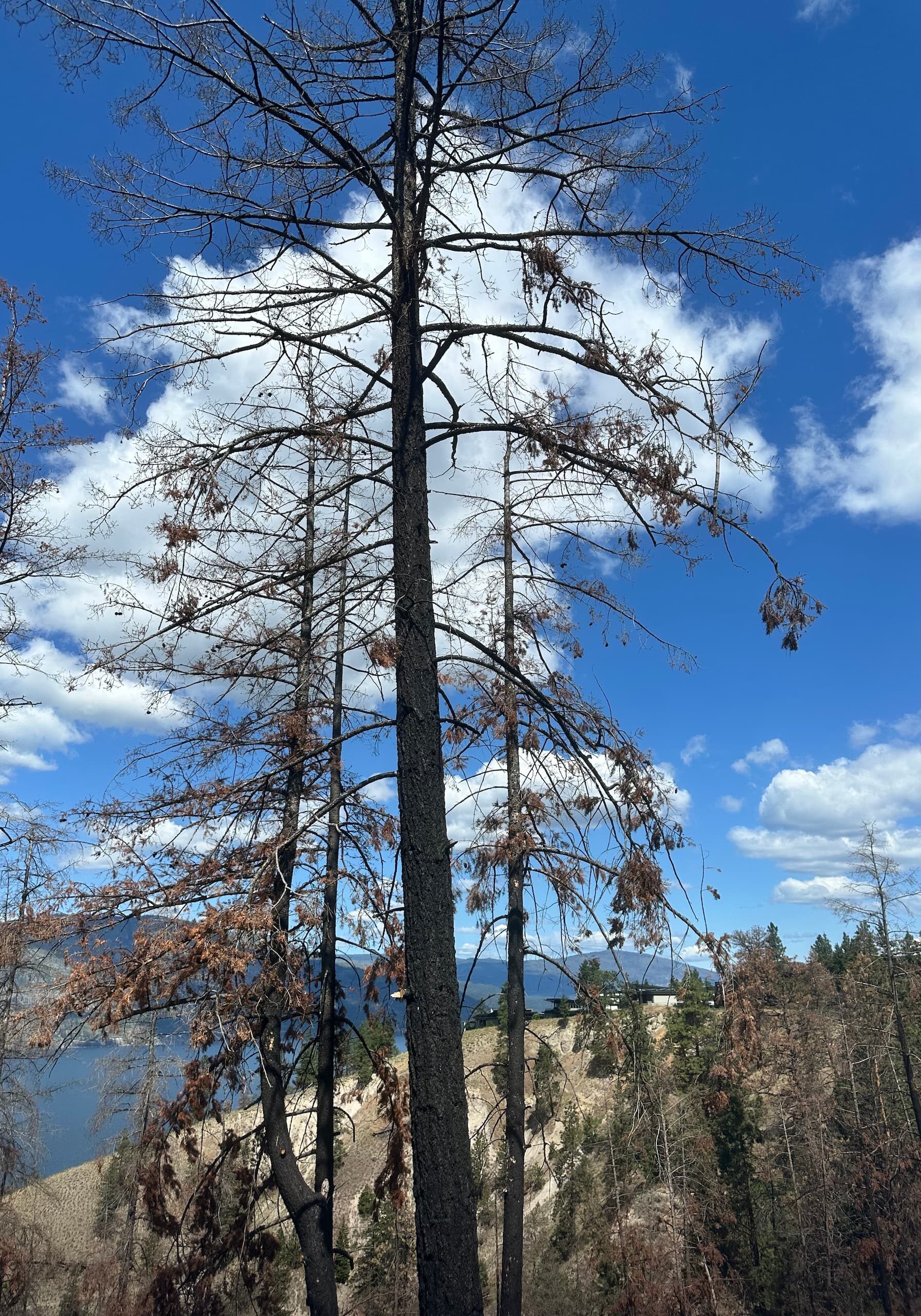
Fire exposure adds another layer of judgment
In fire-prone regions, FireSmart Tree Services can overlap with dangerous tree evaluation in ways clients do not always expect. A tree may not be failing structurally at the moment, yet it may still pose a management problem because of its location, form, dead material, or interaction with surrounding vegetation.
That does not mean every tree near a structure should be removed. It means arborists have to consider how tree condition and placement affect broader site safety. Pruning dead material, adjusting crown spacing where appropriate, and removing specific hazardous trees can be part of a larger property strategy. If a tree already has structural defects and also sits in a high-exposure location, the case for removal can become stronger.
The same caution applies here as in all tree risk work. Professional judgment matters because over-thinning, topping, or aggressive removal can create new problems, including unstable regrowth or avoidable site damage.
Sometimes the conversation turns to preservation, not removal
A surprising number of dangerous tree calls end with a preservation plan.
That may include Tree Cable and Bracing for a weak union, selective reduction of overextended limbs, removal of deadwood, or periodic reinspection. None of those treatments makes a tree risk-free. No tree is risk-free. What they can do is lower the likelihood of failure or reduce the size and weight of parts that might fail.
This is where a seasoned arborist earns trust. Homeowners are often braced for the worst, especially when they see visible defects. A good arborist explains the trade-offs plainly. Cables and braces require ongoing oversight. Reduction pruning can help, but it changes crown architecture and may need repeating. Restricting access under a vulnerable section may be sensible in a low-use area but unrealistic over a front entrance. Removal may cost more upfront than pruning, but repeated intervention on a declining tree may cost more over time.
Those are not sales points. They are management realities.
When removal is recommended, the evaluation continues all the way through the plan
A removal recommendation is not the end of assessment. It is the start of execution planning.
The arborist still has to determine how the tree can be removed safely, what sections need to be controlled, what nearby targets are at risk during dismantling, and whether the site allows for direct felling or requires piece-by-piece removal. This is especially true for trees near structures, tight property lines, or utility corridors. The condition of the wood also matters. A brittle dead tree may need a very different approach from a live but structurally compromised one.
Clients often think of removal as a simple yes-or-no decision. In practice, it includes a sequence of smaller evaluations: access, rigging points, stability during cutting, drop zones, and cleanup needs. If the tree has a large stump in a usable area, Stump Removal & Grinding may also enter the conversation. That is not part of danger assessment itself, but it is often part of the full site plan after removal, particularly where tripping hazards, replanting, or restoration matter.
What homeowners can do before the arborist arrives
Property owners do not need to diagnose the tree, and they should not try to test a suspect tree by pulling limbs, climbing it, or cutting into damaged areas. What they can do is observe and document.
- Note any recent changes such as a new lean, cracks, hanging limbs, or soil movement
- Pay attention to what lies within striking distance, including roofs, walkways, and parking areas
- Restrict access beneath obviously compromised branches when practical
- After storms, assume broken or partially failed wood may still be under load
- Arrange a Certified Arborist Consultation rather than relying on casual opinions
That last point is worth underscoring. Tree risk work is one of the clearest cases where expertise matters. Arborists are trained to evaluate trees systematically and to recommend measures that reduce risk without unnecessary intervention. Because pruning or removing trees, especially large ones, is dangerous work, the evaluation and the work itself belong in trained hands.
Why experienced arborists sometimes disagree
Homeowners are occasionally frustrated when two professionals offer different recommendations. One suggests pruning and support. Another recommends complete removal. That difference does not automatically mean one person is careless or dishonest.
Tree risk assessment includes judgment. Since no tree is completely safe, the decision often turns on what level of residual risk is acceptable, what targets are present, and how confident the arborist is that mitigation measures will hold up over time. Two competent professionals can look at the same co-dominant stem over a garage and weigh the value of pruning, support, and future monitoring differently.
That is also why the best consultations sound specific, not absolute. An experienced arborist will explain what defect is present, what could fail, what the likely targets are, and what the practical treatment options look like. They will also be honest about uncertainty. Trees are living structures. Risk can be assessed systematically, but it cannot be reduced to guarantees.
The real value of the evaluation
The public tends to see the visible part of tree work, ropes, chainsaws, chippers, trucks. The more important part often happens earlier and quieter, when an arborist stands back, studies the tree, and decides whether removal is truly necessary.
That evaluation protects more than property. It protects good trees from unnecessary removal and unsafe trees from wishful thinking. It separates a manageable defect from a failing structure. It identifies when Tree Pruning & Crown Shaping can buy stability, when Tree Cable and Bracing is appropriate, when Emergency Tree Services are needed immediately, and when Dangerous Tree Assessment and Removal must end in a dismantling plan.
A careful arborist does not treat every defect as a death sentence. They treat it as a signal to look closer. That discipline is what makes professional tree risk evaluation so valuable, especially when the stakes are high and the easiest answer is not always the right one.
Name: Ace Tree Services Ltd.
Address: 4656 Wallace Hill Road, Kelowna, BC
Phone: 250-212-9593
Website: https://acetree.ca/
Hours:
Monday: 7:00 AM–5:00 PM
Tuesday: 7:00 AM–5:00 PM
Wednesday: 7:00 AM–5:00 PM
Thursday: 7:00 AM–5:00 PM
Friday: 7:00 AM–5:00 PM
Saturday: 7:00 AM–5:00 PM
Sunday: Closed
Emergency tree services: 24/7 emergency service is listed.
Open-location code / Plus code: RHF8+8G Kelowna, British Columbia, Canada
Map/listing URL: https://www.google.com/maps/place/Ace+Tree+Services+Ltd./@49.8232606,-119.4337283,563m/data=!3m1!1e3!4m6!3m5!1s0x537d8b1d074815c5:0x450b88afa7a41435!8m2!3d49.8232606!4d-119.4337283!16s%2Fg%2F11ydkpnh22
Embed iframe:
Socials: https://www.facebook.com/people/Ace-Tree-Services/61585901931447/
https://m.yelp.com/biz/ace-tree-services-kelowna
Ace Tree Services Ltd. provides professional tree service for residential, commercial, and municipal customers in Kelowna and across the Okanagan Valley.
The company’s listed services include tree removal, stump removal and grinding, tree pruning and crown shaping, emergency tree services, certified arborist consultation, dangerous tree assessment, tree cable and bracing, and wildfire mitigation.
Ace Tree Services works with homeowners, businesses, property managers, and public-sector clients that need safe, practical tree care in the Kelowna area.
The official site highlights ISA-certified arborists, insurance, and experience handling both routine and complex tree service situations.
Customers can contact Ace Tree Services for tree care planning, hazard concerns, emergency tree cleanup, pruning needs, stump grinding, or advice about trees near homes, fences, driveways, and landscaping.
Ace Tree Services lists regular work hours from 7:00 AM to 5:00 PM Monday through Friday, with 24/7 emergency tree service available for urgent situations.
For tree service in Kelowna, call 250-212-9593 or visit https://acetree.ca/
The public map listing places Ace Tree Services Ltd. in Kelowna and can help customers find directions to the Wallace Hill Road area.
Popular Questions About Ace Tree Services Ltd.
What services does Ace Tree Services Ltd. provide?
Ace Tree Services Ltd. provides tree removal, stump removal and grinding, tree pruning and crown shaping, emergency tree services, certified arborist consultation, dangerous tree assessment and removal, tree cable and bracing, and wildfire mitigation.
Where is Ace Tree Services Ltd. located?
The official website lists Ace Tree Services Ltd. at 4656 Wallace Hill Road, Kelowna, BC.
What areas does Ace Tree Services Ltd. serve?
The official website describes Ace Tree Services as located in Kelowna and servicing the Okanagan.
What phone number should customers call?
Customers can call Ace Tree Services Ltd. at 250-212-9593.
What are Ace Tree Services Ltd.’s regular hours?
The official website lists work hours as 7:00 AM to 5:00 PM, Monday through Friday. Saturday and Sunday regular hours are not listed and should be confirmed directly.
Does Ace Tree Services Ltd. offer emergency tree service?
Yes. The official website lists 24/7 emergency services for urgent tree situations, including emergency tree removal, dangerous tree assessment, stabilization, and limb or branch cleanup.
Does Ace Tree Services Ltd. have certified arborists?
Yes. The official website states that Ace Tree Services has ISA-certified arborists.
Can Ace Tree Services Ltd. help with wildfire mitigation?
Yes. Wildfire mitigation is listed as one of the company’s tree services.
How do I contact Ace Tree Services Ltd.?
Call 250-212-9593 or visit https://acetree.ca/.
Landmarks Near Kelowna, BC
Wallace Hill Road: A local Kelowna road near the address listed for Ace Tree Services Ltd.
Okanagan Lake: A major Kelowna landmark near residential, commercial, and waterfront properties that may need tree pruning, removal, or hazard assessment.
Downtown Kelowna: A central area with homes, offices, rental properties, restaurants, and commercial sites that may need professional tree care.
Mission / Lower Mission: A well-known Kelowna area with mature landscaping, residential properties, and lake-adjacent homes.
South East Kelowna: A rural and residential area with larger properties, orchards, and tree-care needs that can include pruning, removals, and wildfire mitigation.
Crawford: A residential area near the southeast side of Kelowna where homeowners may need tree trimming, hazard assessment, and stump grinding.
Kettle Valley: A hillside residential neighborhood where tree condition, slope, wind exposure, and defensible-space planning can matter for property owners.
Myra-Bellevue Provincial Park: A major outdoor landmark near southeast Kelowna and a useful point of orientation for nearby properties.
Gallagher’s Canyon: A residential and golf community near southeast Kelowna where tree maintenance and wildfire-conscious vegetation management can be practical concerns.
Orchard Park Shopping Centre: A major central Kelowna retail landmark and reference point for customers traveling across the city.
Highway 97: A major Kelowna corridor connecting neighborhoods, commercial properties, and service routes throughout the region.
Kelowna City Park: A recognizable central landmark near downtown neighborhoods and lakefront properties.
Glenmore: A Kelowna neighborhood with residential and commercial properties that may need pruning, storm cleanup, and general tree care.
Rutland: A large residential and commercial area where customers may need tree removal, pruning, stump grinding, or arborist consultation.
Black Mountain: A hillside community where slope, wind, wildfire exposure, and access can influence tree service planning.
For tree service near these Kelowna landmarks, contact Ace Tree Services Ltd. at 250-212-9593 or visit https://acetree.ca/